
Allowance App for Kids: How to Actually Connect Chores to Money
Updated September 12, 2026 · 6 min read
TL;DR
- •A good allowance app connects the chore directly to the dollar amount — no separate mental math for you or your kid.
- •Fixed weekly allowance and chore-based allowance are different systems; most families actually want a hybrid.
- •Kids Point Tracker lets you set a dollar-per-point rate so allowance updates itself as chores get done, with a full ledger your kid can see.
- •Debit-card allowance apps add monthly fees for something a free point-based wallet already solves for most families.
Most 'allowance apps' are really debit cards for kids with a chore checklist bolted on, and they charge a monthly fee for the card itself. If what you actually want is a simple system where finishing a chore adds real money to a balance your kid can watch grow, you don't need a bank product — you need a point system with a dollar rate attached.
Fixed allowance vs. chore-based allowance
Fixed allowance pays out on a schedule regardless of chores. Chore-based allowance pays only for what's done. Most parenting guidance, including from financial literacy nonprofits, recommends a hybrid: a small fixed amount plus chore-earned extras, so kids learn both responsibility and reliability of income.
The app you use should support both without forcing you into one model — a flat 'you'll get $10 Friday' app doesn't teach the same lesson as one where every finished chore visibly adds to the total.
Setting a dollar-per-point rate
The simplest version: decide what one point is worth (a dollar, a dime, a nickel) and let every chore or good-behavior entry carry a point value. The app does the math from there.
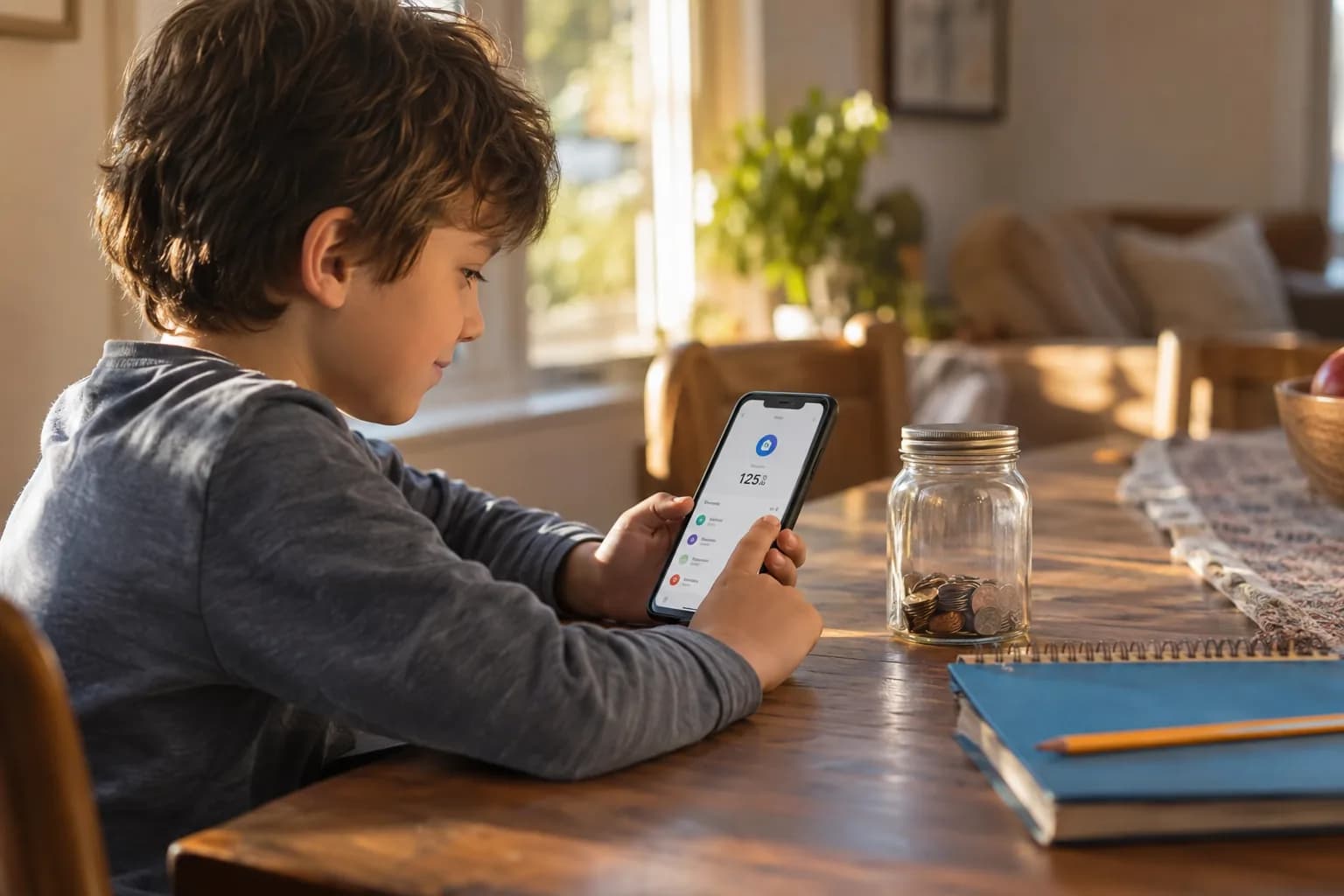
In Kids Point Tracker, you set the 'Rate Per Point' once per child — for example $1 per point — and every task you log afterward adds straight to that child's wallet balance automatically, with the starting balance and every change visible in the ledger.
What a debit-card allowance app adds (and costs)
Apps like Greenlight or GoHenry add a real, spendable debit card and typically charge $4-8/month per family for it. That's genuinely useful once a kid is old enough to spend independently at a store.
For younger kids, or for families who want to track earned value before handing over a card, a free point-and-wallet system covers the actual behavior-building part without a subscription. Kids Point Tracker's wallet is a running ledger, not a spendable card — the money moves in real life once you review it together.
Letting kids see their own history
Kids learn money management faster when they can look back at their own decisions — what they earned, what they spent it on, and when. A ledger with dates and notes turns abstract 'you get an allowance' into a concrete record.
Kids Point Tracker's ledger shows every earn and spend with a date, amount, and running balance, plus an optional photo and note — so a $5 spend shows up next to a photo of exactly what it bought.
Ready to try it with your own kids?
Frequently Asked Questions
What's a fair starting allowance rate for chores?
There's no universal number, but a common starting point used by financial-literacy educators is roughly $1 per year of age per week, split between fixed and chore-earned amounts. Adjust based on your family's budget and the chore list.
Source: Consumer Financial Protection Bureau — Money as You GrowDo I need a kids debit card to teach money management?
No. A debit card teaches spending mechanics; a visible earn-and-spend ledger teaches the underlying habit. Many families start with a ledger-based app like Kids Point Tracker and add a card later as the child gets older.
Can siblings have different allowance rates?
Yes — each child should have their own profile and their own rate-per-point, since a 6-year-old and a 13-year-old shouldn't be on the same pay scale for the same chore.
Is Kids Point Tracker free to use as an allowance tracker?
Yes, the app is free to download and use, including the wallet, ledger, and multi-child profiles.