
20 Kids Point System Ideas Parents Actually Use
Updated September 24, 2026 · 7 min read
TL;DR
- •Point values should scale with effort — a 30-second task and a 20-minute task shouldn't be worth the same.
- •Below is a real starting list: 10 chore ideas, 5 behavior ideas, and 5 reward ideas with sample point values.
- •Adjust every number to your own family — these are starting points, not fixed rules.
- •Every idea below maps directly onto a custom task or reward in Kids Point Tracker.
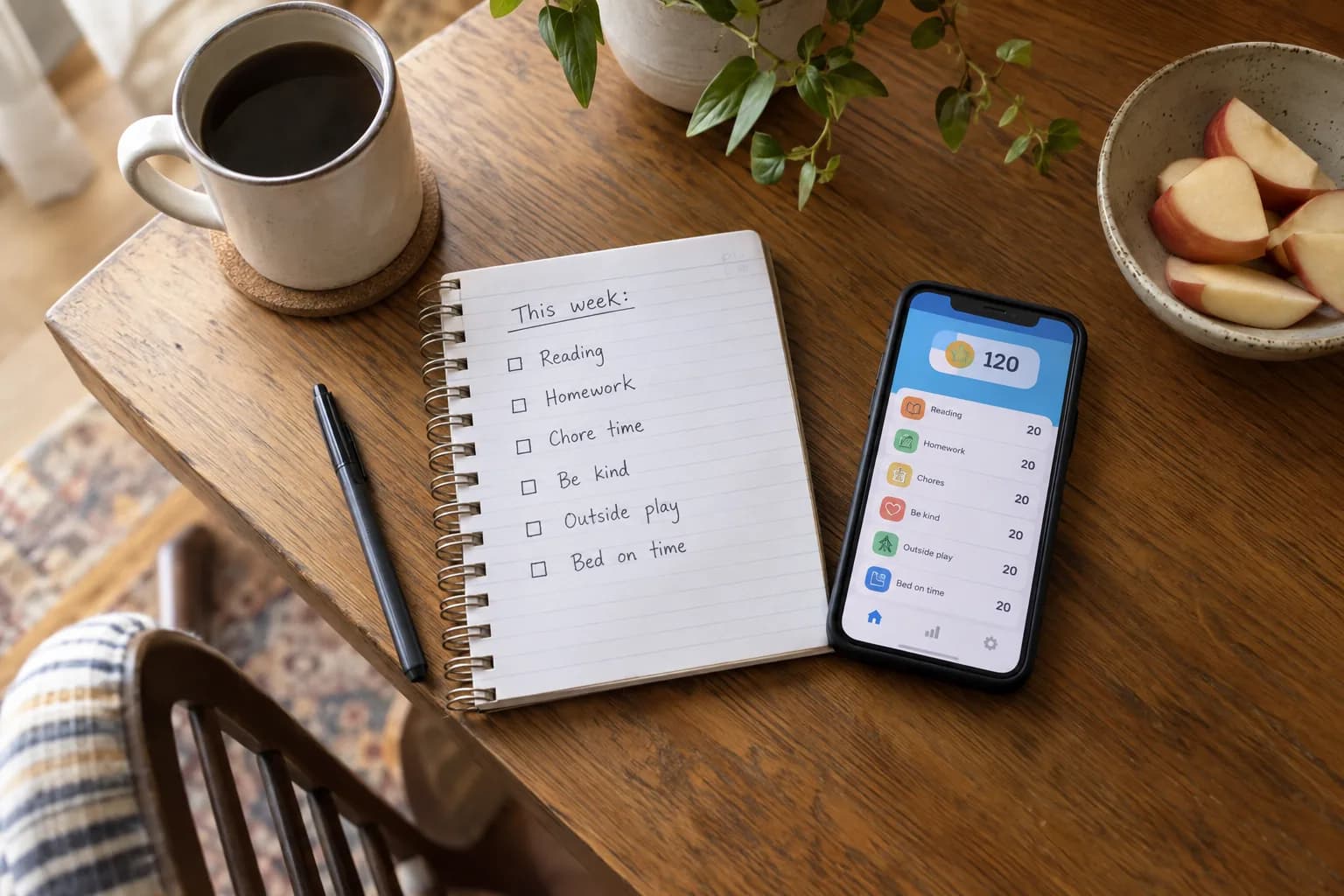
The hardest part of starting a point system isn't the app — it's deciding what's worth how many points. Below is a real, specific starting list covering chores, behavior, and rewards, with sample point values you can copy directly into Kids Point Tracker and adjust for your own family's age range and routine.
10 chore ideas and starting point values
Make bed (1 point) · Brush teeth morning and night (1 point each) · Put toys away (2 points) · Set the table (2 points) · Feed a pet (2 points) · Unload the dishwasher (3 points) · Take out the trash (3 points) · Fold and put away laundry (5 points) · Vacuum a room (5 points) · Mow the lawn (10 points, age-appropriate).
The pattern: quick, near-daily tasks sit at 1-2 points; tasks requiring real time or physical effort sit at 5-10. Keep the scale consistent so a kid can compare two chores and immediately know which is worth more.
5 behavior ideas and starting point values
Used manners without a reminder (1 point) · Shared or helped a sibling without being asked (2 points) · Handled frustration calmly instead of a meltdown (3 points) · Finished homework without reminders (3 points) · Told the truth about a mistake instead of hiding it (3 points).
Behavior points tend to be smaller and more frequent than chore points — the goal is reinforcing a lot of small good moments, not waiting for one big one.
5 reward ideas and sample point costs
Extra 15 minutes of screen time (10 points) · Pick the family movie (15 points) · A small treat or trip to get ice cream (20 points) · A new toy or book under $15 (50 points) · A bigger goal like a pizza party or a day trip (100 points).
Set at least one big, aspirational reward (the 100-point tier) alongside small, frequently-reachable ones — kids stay motivated by having both a quick win and something to save toward.
How to adjust this for your family
These numbers are a starting point, not a rule. If a chore consistently gets ignored, its point value is probably too low relative to the effort — raise it. If a reward never gets redeemed, it might be priced too high; lower it or add a smaller version.
Every item above maps directly onto a custom task or reward inside Kids Point Tracker — set the point value once per child, and adjust any time as your family's routine changes.
Ready to try it with your own kids?
Frequently Asked Questions
How many points should a chore be worth?
Scale it to effort and time: quick daily tasks (making a bed) at 1-2 points, and bigger tasks (mowing the lawn, deep cleaning a room) at 5-10 points, so kids can compare value at a glance.
Should behavior points be worth more or less than chore points?
Generally less per instance, but more frequent — the goal with behavior is reinforcing many small good moments throughout the day, not waiting for one big rare one.
How do I price rewards fairly against points earned?
Include a mix: a few small rewards reachable within a day or two, and one or two bigger aspirational rewards that take a week or more to save toward.
Can I copy this point system directly into Kids Point Tracker?
Yes — every chore, behavior, and reward listed above can be added as a custom task with its own point value for each child's profile.